
The "One Quick Request" Monster (Building Data WITH your users)
Trying to build useful data assets without generating random reports that end up being unused.

Hey person! 🙌 Thanks for checking in. Alejandro here 😊
Suscribe if you like to read about learnings, reflections and other thoughts that can be helpful for your career in tech & data!
Enjoy the reading and let me know in the comments what you think about it 👨🏻💻
If you work in data, especially in a small team, you know the common fear. It's not due to a lack of experience or knowledge. We fear it because it leads to endless problems.
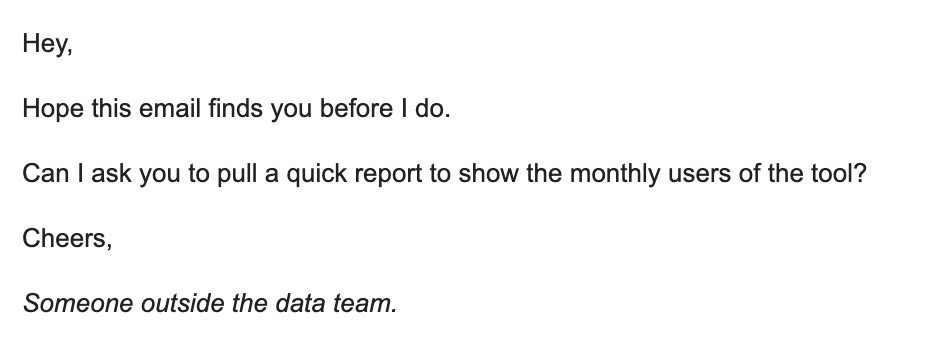
But we shouldn’t fear it…
There is hope at the end of the pipeline (see what I did there?).
The usual advice is to "have initiative, be proactive, and be one step ahead." but it's hard to follow because context defines 99% of it.
You can find nice templates and frameworks, but simple questions for end users are better, in my experience.
As a technical contributor, you might dislike talking with non-technical coworkers in your company. But you'll need to learn to speak non-technical at some point.
If you ask them the right questions, they'll make better, fewer or even more qualified requests next time.
Let’s get started.
🎬Setting the scene
I am assuming you will be talking with someone you don’t usually interact with. Even for small companies, it is likely that the other person will feel less open at the beginning and you will have to break the ice.
My best pieces of advice for this process:
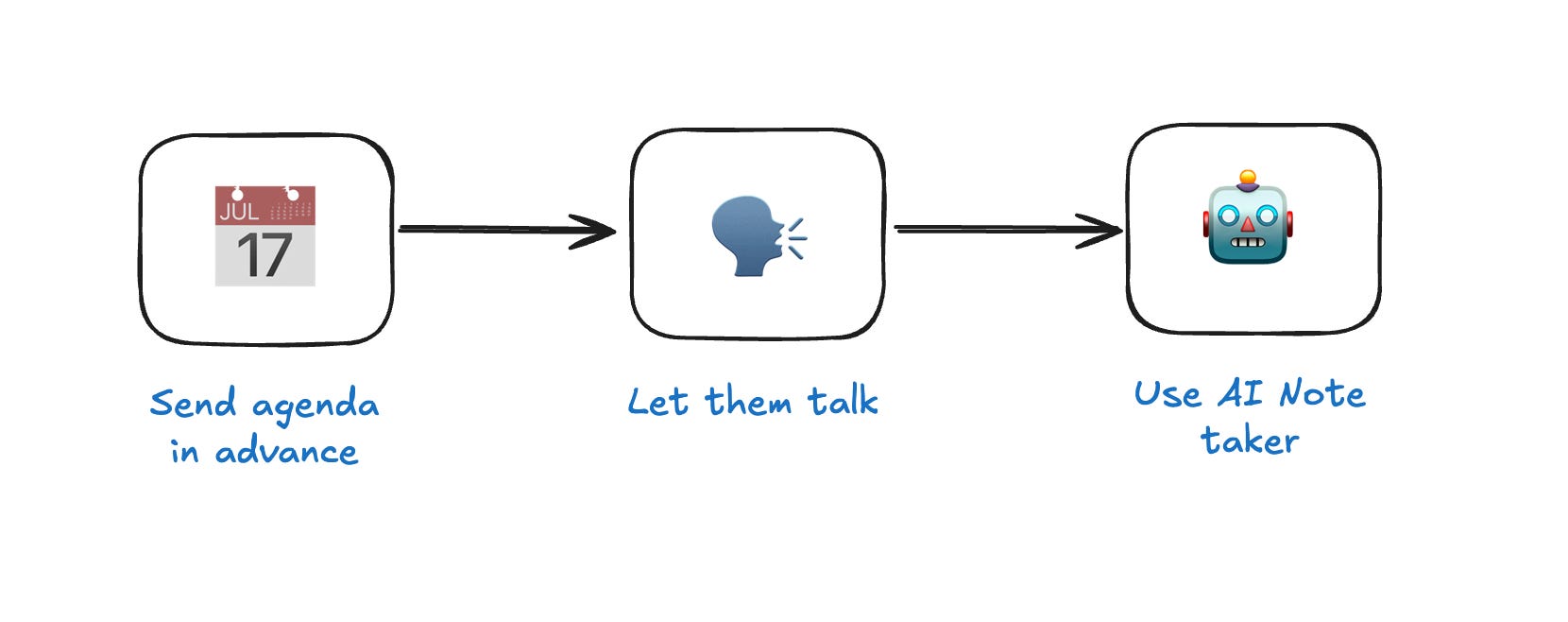
Provide an agenda in advance and be straightforward about the main goal: you want to help THEM.
“Hi End User, how are you doing?"
I've been planning my projects for next quarter. My backlog shows that many of your team's Metabase dashboards are loading slowly.
I’ve booked a meeting for next week to chat about the dashboards you use, the metrics you track, and your usual business questions. We'll also discuss anything else that could help to improve your daily workflow.
Thanks!”
If you are a talker like me, this is not the moment to shine. Start the conversation but let it be to build trust. If possible, don't interrupt.
Use an AI note taker or get consent to record the meeting. But pay attention. It's frustrating to discuss your issues while hearing keyboards in the background (even if muted). There is an exception: if you catch an opportunity that AI won’t, ask for a minute to write it down.
❓Asking questions that will make a difference
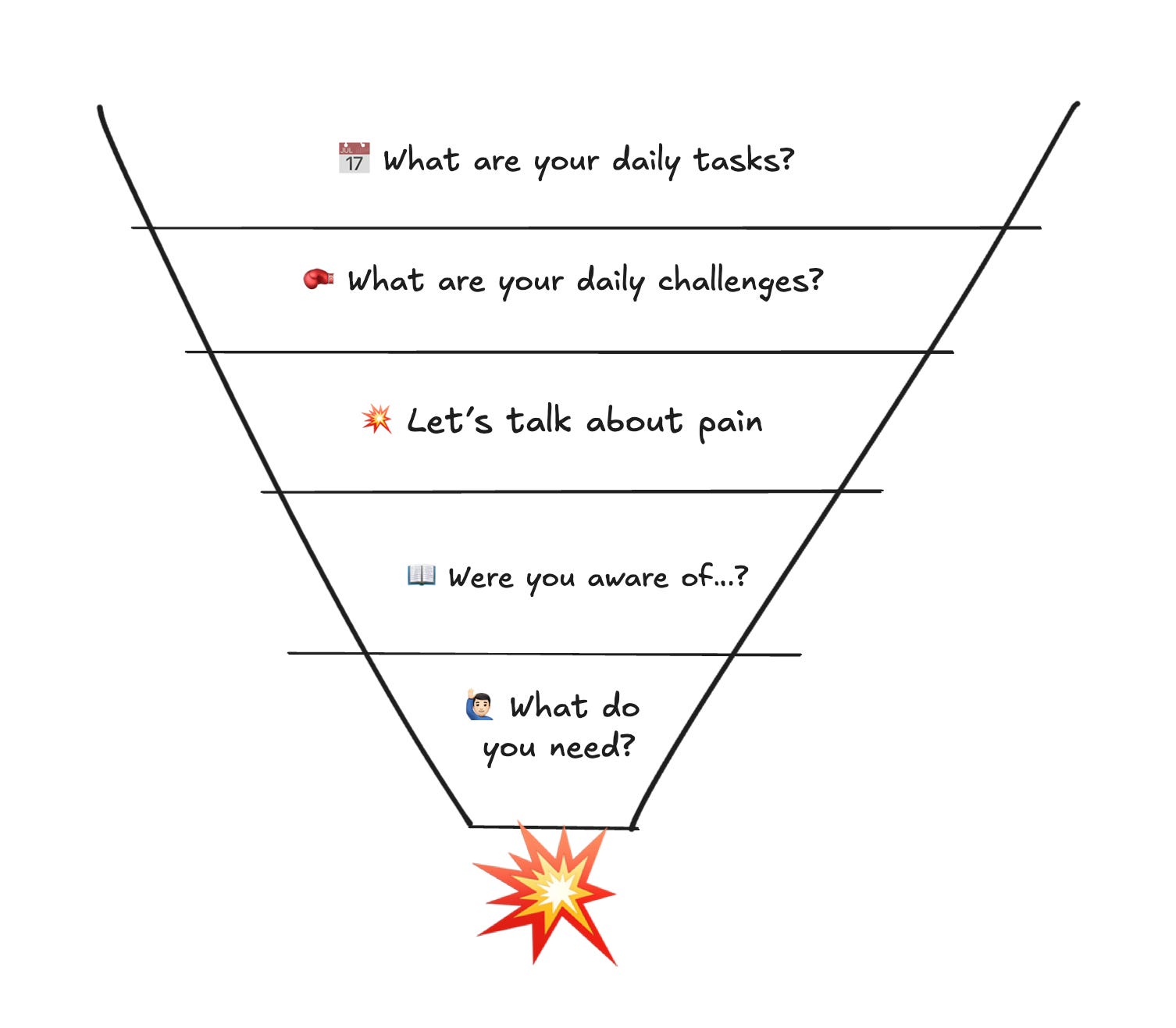
📅 What are your daily tasks?
Most of the time, they don’t explicitly know what they need, and that is fine.
If they don’t know, ask about their daily tasks.
A guided tour through their work assets is sometimes enough. That will open new points for the next steps of the conversation.
If you build dashboards, make them share their screens and show you.
If you build automated emails with insights, ask them what they take from those.
🥊 What are your daily challenges?
After the last step, ask what they cannot do because of their daily tasks. That will let you know what you could improve.
There’s no need to go with the typical question “What keeps you up at night?”. These are my favorites:
“What is taking up most of your time when doing X or Y?”
“How do you proceed when X or Y happens?”
“Is there one impactful thing you should be doing more, but something is pulling you down? If yes, what’s that thing?"
💥 Let’s talk about pain
Try to understand what they are not saying. Most of the time, if someone complains about something, they are saying something else. For example:
"I have no time to check my customers one by one. It makes me unable to anticipate whether a customer will churn."
I have no time; remove the manual task from them if possible.
Check my customers: what's the criterion? Ask for them and develop something that checks it at scale.
Unable to anticipate: are we supposed to do this before a specific event or time in the year? What's the ideal frequency?
Whether a customer will churn: that’s a metric.
Usually, all complaints are disguising a blocker, a metric, a target and the impact of the affected process. This might not apply 100% of the time, but paying attention to these concepts could help.
📖 Were you aware of…?
It's funny when someone complains about a missing thing that was available for over 6 months but never used.
It's up to you, my data friend.
We often don't share available assets with users but you should announce new data products. Also, regularly update others on improvements and maintenance.
This will make a big difference, and the effort is quite low.
Some actionable items for this point:
Use clear names for assets. If everyone refers to it as “User Growth”, don't name the dashboard "Account Activations".
Spend time writing good descriptions as if someone coming from Mars was going to read it, be detailed but don’t rewrite the bible.
Use emojis to catch attention, never gets old. 🙋🏻♀️🙋🏻♂️
But never forget: if you communicate to provide awareness and they don’t pay attention, don’t insist. Whenever they need it, they will come back asking for it.
🙋🏻♂️ What do you need?
Just like the heading title. Simple.
But hold on, don’t get me wrong.
This question usually works with very specific individuals. Not all people know what they need. If they do, they may struggle to express themselvers. This can make it hard for others to understand the issue.
But for others, it could be the best way to start the conversation. Since it’s not the usual flow, I've left the not-so-obvious point for the end.
⚠️ DANGER ⚠️: Sometimes this would be the same as asking “What would you write in a Christmas Card?” and it could create an undesired expectations cocktail. 🤣
👹 The Final Boss: the “one quick report” avalanche
In past experiences working in Analytics, I’ve watched this show from the 1st row, the usual sequence being:
Requester: "Hey, we need this quick report to see how many monthly users we have per country."
Data person: “Hey, I can have it for tomorrow; I need to wrap up some other things first.”
Requester: “I need a quick .csv for a meeting taking place in 2 hours."
Data person: "(5’ later) Okay, there you go."
Requester: “Can you also add monthly actions?”
Data person: “Done.”
Requester: “Can you also add the client type and the weather forecast for tomorrow?”
Data person: “We don’t have that kind of logic.”
Requester: "Oh, okay, I don’t need it anyway. Thanks.”
If this were a film, we could name it: “Harry Potter and the Mystery of why they cannot ask for everything all at once."
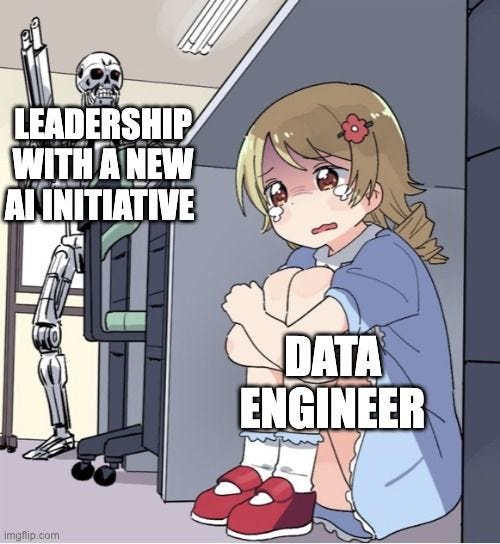
The real question we should always ask, and fight for, is:
Data person: “Hey, what’s the use case for it? What’s the deadline? Who’s going to use it? What questions do we want to answer?”
You must balance flexibility, speed, and realistic scenarios. Otherwise, someone might blame the Data team for artificial bottlenecks.
🧽 My approach to killing the monster in the long term
Catch patterns. If you always get the same request at the end of the month, automate it right away. Don’t be lazy.
Don’t build without context. Just sending .csv exports won’t be enough; there’s always a bigger picture that you might be missing if you only react. Context is king.
Set up metadata reporting. Know who is using what and at what frequency. This provides abundant context without requiring direct inquiry on end users.
All-in Housekeeping. If you pay attention to what’s used and what’s not, you know what’s irrelevant and needs to be removed. Probably in this process you will find mutiple one-shot reports that ended up in analytics oblivion.
Test your audience. What happens if you archive an not so unused report without announcing it? Please, archive without deleting. The ghosts might return and some of those reports could help in the future.
Remove what’s causing noise. They will end up using only what they need. Incredibly, when we have 20 dashboards we can check, we check none of them. But having 3 might lift usage and adoption.
📝 TL;DR
🎬 Setting the scene
Provide an agenda
Let them talk
Use an AI Note Taker or only takes notes of things AI won’t catch. Eg. A Data Product opportunity
❓Asking questions that will make a difference
📅 What are your daily tasks? Get more context on their workflows.
🥊 What are your daily challenges? Find blockers that can be solved with Data.
💥 Let’s talk about pain. Understand what is not being said.
📖 Were you aware of…? Let them know about the data assets they can use periodically.
🙋🏻♂️ What do you need? Straightforward option for the ones that clearly know what they need.
👹 The Final Boss: the “one quick report” avalanche
🧽 My approach to killing the monster in the long-term
Catch patterns and solve them at scale
Don’t build without context. Try not working blindy by doing one quick requests all the time.
Set up metadata reporting. To scout heavy users and get the best out of them.
All-in Housekeeping. To really know what they use and what they don’t.
Test your audience. Try breaking change for forgotten assets, what could happen? Archive without deleting.
Remove what’s causing noise. It’s more likely they use 2 when they have only 2 than 2 when they have 20 dashboards.
If you enjoyed the content, hit the like ❤️ button, share, comment, repost, and all those nice things people do when like stuff these days. Glad to know you made it to this part!

Hi, I’m Alejandro Aboy. I went from marketing analyst to data engineer without a CS degree. Here, I share the lessons, mindset shifts, and stories that helped me build a career I’m proud of — and how you can grow yours too.