
Changing Loading with Thinking and other ways to become AI Native
Companies are shipping AI features before solving the problems their users actually have.

Hey person! 🙌 Thanks for checking in. Alejandro here 😊
Suscribe if you like to read about learnings, reflections and other thoughts that can be helpful for your career in tech & data!
Enjoy the reading and let me know in the comments what you think about it 👨🏻💻
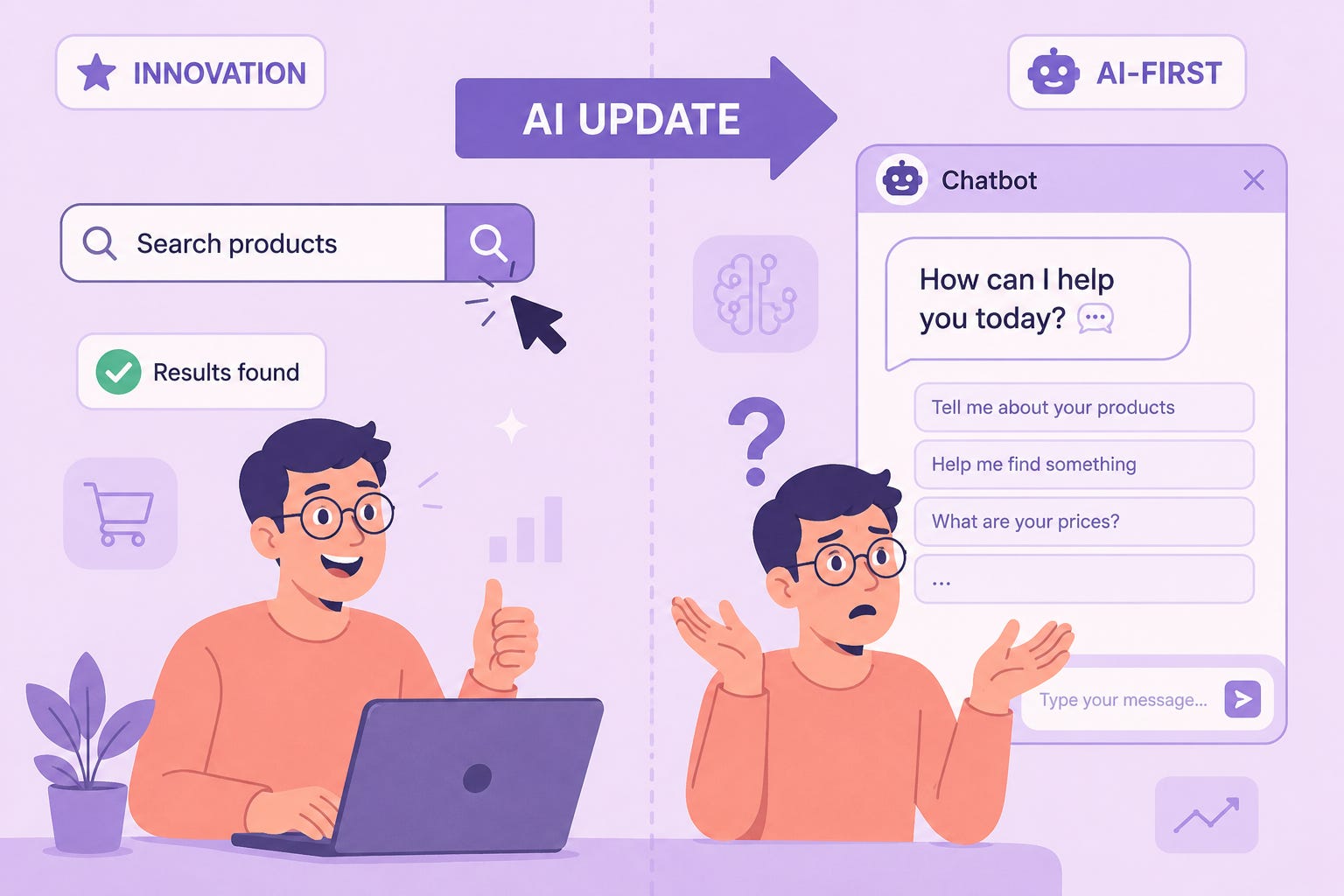
A couple days ago, I tried to find a board in Miro. What previously was a quick search input, now is an AI input.
Surprise, I failed to find in the first 2 attempts a board that I knew the name for. Which is quite dramatic 🤣
Been lately seeing a lot of chatbots that really don’t help at all: semantic search, fancy tools, MCP connections and all the LLM shiny buzzwords just to answer questions about documents that are outdated.
All because companies are rushing to AI without thinking in all the s** they need to figure out first.*
All so users get a friendly “How can I help you today?” blocking the screen every time they log in. As if we switched from cookie banners to AI chats.
We Are AI (Sloppy) First
If you work with enterprise-y customers, they will tell you they need it all.
It’s like someone in leadership saw a competitor’s demo, and three weeks later we were “AI-first.” (”but first we need AI tools”)
And the irony here is that best way to remove that need is to... release the thing with AI.
The human being is not able to accept even today that we can’t try all that’s out there, we are overwhelmed and the adoption becomes a process of cutting down what to focus on rather than long term gradual learning.
The worst AI Slop is the “just because” products and false solutions created in the name of the AI revolution.
Diagnosing AI-Hyped In Companies
You can tell when a company crosses from “AI that solves a problem” to “AI because it’s cool” by watching for these patterns:
No use case backed the decision. The team wrapped an API call around the most visible feature they could find. Then that became 21 wrappers and counting.
Disconnected LLM calls dressed as features. A summarizer here. A “smart suggestion” there. A recommendations powered AI. None of them talk to each other. None fit a workflow.
Multimodal that nobody asked for. Typing is boring but people don’t really want to talk to AI in an open office space. Image recognition to analyze images that are 99% text that could be copy pasted and saves the OCR implementation.
Audience mismatch. Your users are 55-year-old accountants who’ve been using your product since 2018. They don’t want a conversation. They want the dropdown menu you removed to make room for the chat window.
A working flow got replaced by a worse one. There was a 3-click process. It worked. Now it’s a conversational interface that requires typing, parsing, and hoping the model understood. You added friction and called it innovation.
And that’s how AI powered becomes AI powerless.
The B Side of adding AI everywhere
Every AI feature that doesn’t solve a real problem creates three new ones.
The software engineering laws KISS and YAGNI can be applied here to understand how this goes:
More Supervision: Wrong support ticket triage requires becomes more complex since now you can cover more, but also there’s more risk AI misses the real issue or forces ticket creation because LLMs don’t know how to not do something.
Trust issues cascade: Once someone gets a confidently wrong answer from your chatbot, they question everything else too.
Maintenance hell: The team now maintains an AI layer on top of the existing product instead of improving the product itself. Prompt, models and all the issues around that cause a lot of distractions.
How To Kill 90% Of These Unwanted AI Features
I’ve discovered questions that help to save a lot of time here.
About sizing:
If users are having already a good experience, would they benefit from increasing the scale?
AI amplifies whatever you give it, so here It could be relevant. Getting data at scale for analytics is always a good example, but if that means too much to handle, AI will happily hallucinate to get that big report of yours.
Adding dynamic experiences:
If there’s a need for flexibility that static features can cover, would AI help guiding users to achieve that outcome?
AI Agents with the right tools can unlock many things that regular UIs can’t do these days. This doesn’t mean everything should be conversational, but it’s always hard to figure out all paths possible when designing products, so AI Agency with the right harness can take things to the next level.
Handling risks of AI messing up:
Is the risk of non deterministic something users will tolerate? Or will It hurt your product perception?
If users get expectations about AI helping them to build PowerPoints and after long conversations the presentation is s***, they might not pay for the AI Agent feature again, expectations are high these days so don’t rush to put things out there that can consistently match those.
If you are not adding anything bigger, faster or better with AI but just extra steps for something that was working fine, users will hate your product for the wrong reasons.
If It ain’t broken don’t fix it add AI to It.
If you enjoyed the content, hit the like ❤️ button, share, comment, repost, and all those nice things people do when they like stuff these days. Tell me what you think about it!

Hi, I’m Alejandro Aboy. I went from marketing analyst to data engineer without a CS degree. Here, I share the lessons, mindset shifts, and stories I got from a career in Data.
Maybe the data engineers should make all AI solution decisions! Here's another guideline: only fix things that are broken :)